Fear of Wide Open Spaces: What It Is Called and What It May Mean
The fear of wide open spaces can feel confusing because different people mean different things by it. One person may feel exposed in a huge parking lot. Another may panic in a public square because leaving quickly feels difficult. Someone else may be uneasy in an empty field because the space feels too blank, silent, or endless. If you are trying to understand that pattern, a private agoraphobia and panic self-check can be a gentle first step for reflection, not a formal diagnosis or a replacement for professional care.
This guide explains the main terms people use, especially agoraphobia and kenophobia, and shows how wide open spaces can connect with crowds, going outside alone, panic sensations, or fear of not finding help.
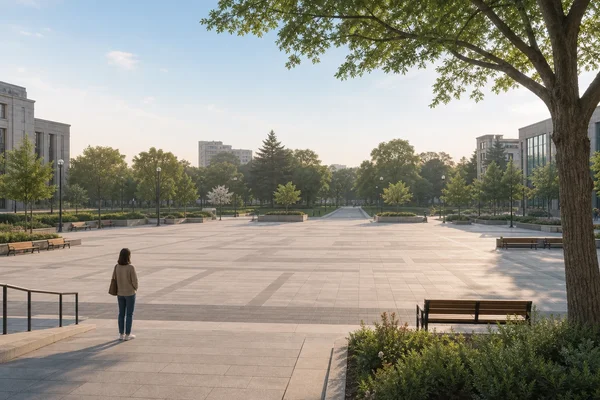
Why Wide Open Spaces Can Feel Threatening
A wide open space is not automatically dangerous, but the body can still read it as unsafe. The feeling may show up as a racing heart, dizziness, tight breathing, sweating, stomach discomfort, shaky legs, or a sudden urge to leave. For some people, the hardest part is the lack of walls, corners, exits, or familiar landmarks. For others, the worry is more practical: "What if I panic out here and cannot get help quickly?"
That difference matters. A fear of wide open spaces may be about the space itself, the emptiness of the scene, the distance from safety, the possibility of panic, or the social visibility of struggling in public. It may also overlap with fear of going outside alone, fear of crowds, fear of public transport, or fear of standing in a line where leaving would feel awkward.
When anxiety keeps choosing the same places to avoid, the map of daily life can slowly shrink. A person may skip large stores, bridges, open plazas, beaches, fields, highways, malls, or parking lots. They may ask someone to come with them, sit near an exit, check the route repeatedly, or leave before the anxiety peaks. These behaviors are understandable attempts to feel safe, but repeated avoidance can make the feared place feel even more powerful over time.
Is the Fear of Wide Open Spaces Agoraphobia or Kenophobia?
The two terms most often connected with this topic are agoraphobia and kenophobia. They can overlap in real life, but they do not point to exactly the same fear.
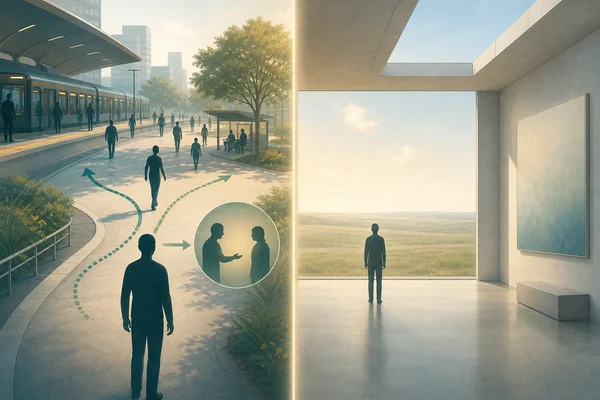
Agoraphobia focuses on escape and help
Agoraphobia is commonly associated with fear or avoidance of situations where escape might feel difficult, help might seem unavailable, or panic-like symptoms might feel embarrassing or overwhelming. The feared situations can include public transportation, open spaces, enclosed places, crowds or lines, and being outside the home alone.
So if a person feels afraid in a wide open plaza because they worry they might panic, faint, lose control, or be unable to reach help, the pattern may resemble agoraphobic fear. The core issue is not always "open space" by itself. It is often the thought that the person could become trapped by symptoms, distance, crowds, social attention, or lack of support.
Agoraphobia can also appear with or without panic attacks. Some people mainly fear the place. Others mainly fear what their body might do in the place. This is one reason a self-reflection tool can help organize observations, while a qualified professional is still needed for formal clinical judgment.
Kenophobia focuses on emptiness or void-like space
Kenophobia is usually described as an intense fear of empty spaces, blank spaces, or voids. A person with kenophobia may feel distressed in an empty room, an open field, a vast landscape, or a space that feels unusually blank. The fear may be triggered by the visual emptiness or the sense that the environment lacks expected objects, boundaries, or reassurance.
This is different from agoraphobia when the main fear is not panic, escape, or access to help, but the empty quality of the space itself. A person might feel uneasy in a quiet warehouse even if the exit is visible. Another might feel disturbed by an endless-looking landscape even when they are not worried about crowds or public embarrassment.
Fear of heights is a separate clue
Fear of heights is usually called acrophobia. It can overlap with wide open places, especially on bridges, cliffs, balconies, rooftops, or open staircases. But if the fear appears mainly when there is height, drop-off, or a sense of falling, the pattern is different from fear of empty space or fear of being unable to get help.
The practical question is: what part of the scene makes your body react first? Is it the openness, the emptiness, the height, the distance from support, the crowd, or the thought of leaving home alone?
A Simple Way to Sort the Pattern Without Self-Labeling
You do not need to force a label immediately. It is often more useful to observe the pattern in plain language. The following questions can help you separate wide open empty spaces from public-space anxiety and panic-related avoidance.
Ask yourself:
- Do I feel anxious in open places even when they are quiet and easy to leave?
- Does the fear get stronger when I am alone?
- Am I mainly worried about panic sensations, fainting, losing control, or needing help?
- Do crowds, lines, public transportation, or enclosed places create a similar reaction?
- Do I avoid the place, endure it with intense distress, or need a companion?
- Does the fear last for months and interfere with errands, work, school, relationships, or health appointments?

If your answers cluster around panic, escape, help, public situations, or being outside alone, the pattern may be closer to agoraphobic anxiety. If your answers cluster around blankness, vastness, emptiness, or void-like space, kenophobia may be a closer word to explore. If both are true, that is also possible; lived anxiety does not always stay inside neat vocabulary boxes.
For a low-pressure way to organize these observations, you can review gentle screening questions about public spaces and use the results as notes for your own reflection or for a later conversation with a mental health professional.
What Helps When Open or Empty Places Feel Hard
The goal is not to shame yourself into walking into the hardest place first. A safer approach is to understand the fear loop and make changes gradually. The loop often looks like this: a place feels unsafe, the body reacts, escape brings short-term relief, and the brain learns to flag that place even faster next time.
One useful first step is a trigger map. Write down three recent moments when wide open spaces felt difficult. For each one, note the location, who was with you, what you feared would happen, what body sensations appeared, what you did next, and how long it took to settle. Patterns usually become clearer when they are outside your head and on a page.
Next, create a ladder of easier-to-harder situations. An easier step might be looking at a photo of an open field, standing at the edge of a quiet parking lot for two minutes, or walking with a trusted person across a small open area. A harder step might be crossing a large plaza alone or staying in an open store aisle during mild anxiety. Keep the steps small enough that practice feels challenging but not reckless.
Grounding skills can also help during practice. You might name five visible objects, press your feet into the ground, lengthen your exhale, describe the nearest exit, or remind yourself that anxiety can rise and fall without requiring an immediate escape. These skills do not erase fear instantly, but they can reduce the feeling that the only option is to flee.
If symptoms are intense, long-lasting, or limiting important parts of life, professional support matters. Therapies such as cognitive behavioral therapy and carefully guided exposure are commonly used for phobias and agoraphobic patterns. Medication questions, including medication fear, should be discussed with a licensed clinician who can consider your history and preferences.
When Open Spaces Are Not the Whole Story
Sometimes "fear of wide open spaces" is the phrase people use because it is the most visible part of the problem. Underneath, there may be several related concerns:
- Fear of leaving the house because home feels like the only controllable place.
- Fear of going outside alone because support feels too far away.
- Fear of crowds because leaving would attract attention.
- Fear of public transport because exits are limited.
- Fear of bridges or large roads because the route feels exposed.
- Fear of panic sensations because the body feels unpredictable.
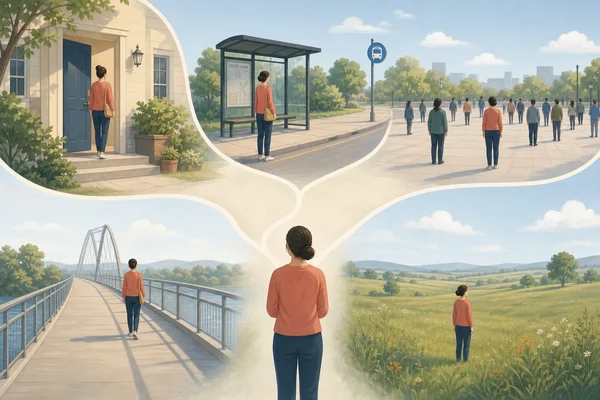
This is why the phrase "agoraphobia is the fear of open spaces" can be too narrow. Open spaces are one common situation, but the broader pattern often involves avoidance, perceived escape difficulty, and worries about help, panic, or public distress.
It can be helpful to describe your experience in complete sentences instead of labels. For example: "I can stand in a small room, but I feel unsafe crossing a large parking lot alone," or "I am fine in empty parks with a friend, but panic in crowded malls." Those details give you and any support person more to work with than a single phobia name.
A Gentle Next Step for Understanding Your Pattern
If the fear of wide open spaces is making your world smaller, the next useful step is usually information, not pressure. Notice which spaces you avoid, what you fear would happen there, and whether the pattern is tied to emptiness, escape, help, height, crowds, or being alone. That information can guide safer coping choices and better conversations with a professional if you choose to seek support.
You can also explore a free agoraphobia and panic reflection tool if you want a structured way to think through public-space fear. Treat any result as a starting point for self-understanding, not a final label.
FAQ
Is there a phobia for wide open spaces?
There is not one perfect term for every version of fear in wide open spaces. If the fear is mainly about being in places where escape or help feels difficult, agoraphobia may be relevant. If the fear is mainly about blank, empty, or void-like spaces, kenophobia may be the closer term. If height is the main trigger, acrophobia is a separate possibility.
What is the difference between agoraphobia and kenophobia?
Agoraphobia usually centers on situations where panic-like symptoms, escape difficulty, lack of help, or public distress feel threatening. Kenophobia centers more on empty spaces, blankness, or void-like environments. A large empty field could trigger either pattern depending on what the person fears most in that moment.
Can fear of open spaces happen without agoraphobia?
Yes. A person may fear open spaces because of emptiness, height, past experiences, sensory overload, unfamiliar places, or specific panic memories. Agoraphobia is only one possible framework. The details of the fear, avoidance, duration, and life impact matter more than the label alone.
Why am I afraid of going outside alone?
Going outside alone can feel hard when the brain links being alone with less safety, less control, or less access to help. It can also connect with panic symptoms, social visibility, or previous frightening experiences. If the fear is limiting daily life, consider speaking with a qualified mental health professional.
Is fear of heights the same as fear of wide open spaces?
No. Fear of heights is usually called acrophobia. It may appear in open places like bridges, balconies, or cliffs, but the main trigger is height or falling rather than openness itself. Tracking the first trigger you notice can help separate these patterns.
How is pharmacophobia related to this topic?
Pharmacophobia means fear of medication or medical treatments. It is not the same as fear of wide open spaces, but it may appear in related searches because both involve anxiety and avoidance. If medication worries affect your care, discuss them with a clinician instead of trying to manage the concern alone.
What fear is athazagoraphobia?
Athazagoraphobia is commonly used to describe fear of being forgotten, ignored, or sometimes forgetting someone or something important. It is separate from agoraphobia, kenophobia, and fear of wide open spaces, even though the words look similar.