AI Agoraphobia Test: Personalized Mental Health Insights Explained
The worlds of artificial intelligence and mental health are coming together, offering new ways to understand conditions like agoraphobia. These advancements bring powerful tools, but also important questions. How does an AI-powered agoraphobia test actually work, and can you trust its personalized insights? This article will demystify the technology behind our confidential symptom checker.
We'll explore how modern algorithms transform your anonymous answers into a meaningful, individualized analysis. This process respects your privacy while delivering valuable mental health insights. It's a first step toward understanding your feelings, powered by technology designed to help. If you're curious about your own symptoms, you can try our free tool at any time.
How Our AI Analyzes Agoraphobia Patterns
Understanding how an AI mental health test works helps build trust in the results. Our system is more than just a simple quiz. It's a sophisticated tool designed to identify patterns that might otherwise go unnoticed. It starts with your responses and uses advanced analysis to build a clear, confidential picture of your experiences. Let's look at how this process unfolds.
From Question Responses to Symptom Mapping
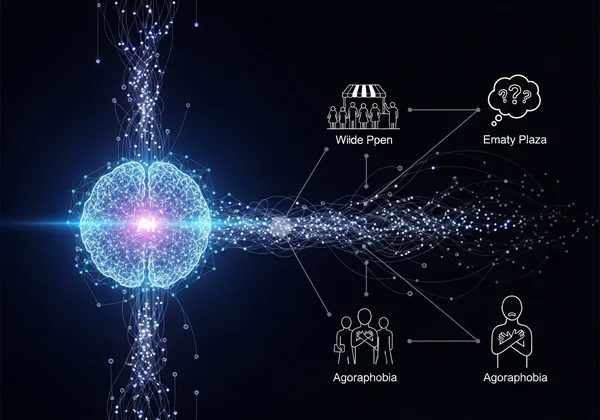
When you take the test, you answer a series of questions about your feelings in different situations. These questions are carefully designed based on established psychological criteria for agoraphobia. The AI's first job is to map your responses to these criteria. It doesn't just count "yes" or "no" answers. Instead, it looks at the intensity and frequency of your feelings.
For example, feeling slight discomfort on a crowded bus is different from experiencing intense panic that makes you avoid public transport altogether. The AI quantifies these nuances, creating a detailed symptom map. This map forms the foundation of your personalized report. It translates your subjective experiences into structured data that can be analyzed for deeper patterns.
Identifying Hidden Correlations in Anxiety Patterns
This is where the power of AI truly shines. Unlike a static checklist, our AI can identify hidden correlations between your answers. It might notice that your fear of open spaces is strongly linked to situations where you feel "trapped." It could also find that your anxiety is most severe when you are alone. These are connections you might not consciously make about your own behavior.
The algorithm analyzes thousands of data points from anonymized user responses. This helps it recognize complex anxiety patterns. It can highlight specific symptom combinations that point toward particular types of challenges. This allows the system to provide insights that go beyond a generic score, offering a more refined understanding of your personal experience with anxiety.
Personalized Anxiety Analysis: Beyond Generic Results
Many online tests give you a simple "low," "medium," or "high" risk score. While helpful, this often leaves you with more questions than answers. A truly personalized anxiety analysis goes much deeper. It aims to provide context and clarity, helping you understand the "why" behind your score.
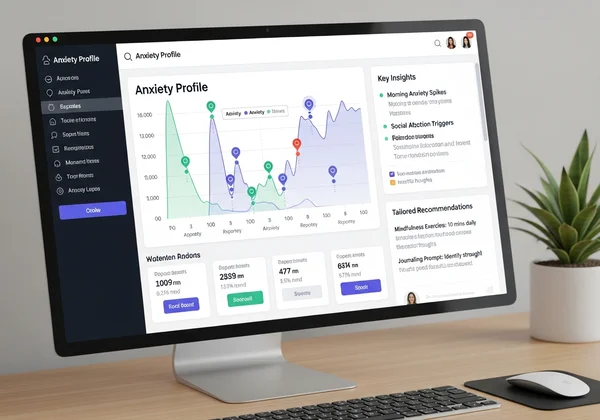
Our goal is to move beyond generic labels and offer you a tool for self-exploration. By leveraging AI, we can create a report that reflects your unique situation. This empowers you to take the next steps on your mental health journey with greater confidence and understanding. You can get started and see your results in just a few minutes.
Creating Your Unique Anxiety Profile
After the AI maps your symptoms and identifies correlations, it combines this information to create your unique anxiety profile. This isn't just a summary of your answers. It's a holistic view of how different aspects of agoraphobia-related anxiety may be affecting you. The profile highlights your primary challenges, such as a strong fear of specific places or situations.
It may also point out your strengths, like areas where you experience less distress. For example, your profile might show that while you struggle with enclosed spaces, you feel relatively comfortable in open parks. This level of detail helps you see your situation more clearly. It turns a vague sense of anxiety into a concrete set of patterns you can begin to address.
Tailored Recommendations Based on Your Specific Triggers
The most valuable part of a personalized analysis is actionable guidance. Based on your unique anxiety profile, our AI system provides tailored recommendations. If your results indicate a significant fear of panic attacks in public, the report might suggest exploring grounding techniques or learning more about cognitive-behavioral therapy (CBT).
These suggestions are not a diagnosis or a treatment plan. Instead, they are educational starting points designed to guide your research and conversations with a healthcare professional. By connecting insights to potential next steps, the analysis becomes a practical tool for positive change. It points you toward resources that are most relevant to your specific triggers and challenges.
Ensuring Privacy in AI Mental Health Assessments
When using any online health tool, privacy is paramount. We understand that discussing mental health requires a safe and confidential space. That’s why we have built our platform with a "privacy-first" approach. We are committed to protecting your information and ensuring your experience is completely anonymous.

Transparency is a core part of building trust. We want you to feel secure, knowing that your data is handled responsibly at every step. This commitment to privacy in AI assessments is not just a feature; it is a fundamental promise to our users.
Your Data Security Protocol Explained
Your privacy is our top priority from the moment you start the test. We don't require you to create an account, log in, or provide any personally identifiable information like your name or email address. Your session is completely anonymous. The responses you provide are processed by our AI algorithm without being linked to your identity.
Furthermore, we use secure protocols to protect the data during analysis. The insights generated are for you alone and are presented in a way that ensures confidentiality. When you choose to receive the enhanced AI report, any additional context you provide remains anonymous. This strict data security protocol means you can explore your feelings honestly, without fear of your information being compromised.
The Human Oversight Behind Your AI Analysis
Technology alone is not enough, especially in the sensitive area of mental health. That's why our AI system is not fully autonomous. The insights and patterns generated by the algorithm are informed by established psychological principles and research. The test questions and the framework for analysis are based on scientifically-informed criteria related to agoraphobia.
This human-in-the-loop approach ensures that the technology serves a constructive purpose. It balances the analytical power of AI with the nuanced understanding of human psychology. This combination helps us provide a tool that is both technologically advanced and grounded in credible mental health expertise, giving you insights you can trust.
Your Next Steps Toward Understanding Agoraphobia
When you understand how AI works to personalize mental health assessments, you're better equipped to take meaningful steps forward on your journey. Our experience shows how technology and psychological expertise work together to transform simple answers into the detailed, personalized profile you receive. This offers a modern, accessible way to explore feelings of anxiety.
Our agoraphobia test is designed to provide insights that help you better understand your unique patterns and triggers. It’s a confidential, free, and immediate first step. Experience the difference AI can make in your self-assessment.
Ready to gain a clearer perspective? Start your test today and discover personalized insights tailored to your unique experience.
Frequently Asked Questions About AI Agoraphobia Tests
How accurate is AI compared to human diagnosis in detecting agoraphobia?
An AI-powered test like ours is a screening tool, not a diagnostic tool. It is designed to identify patterns and risk levels with high accuracy based on your responses. However, it cannot replace a formal diagnosis from a qualified healthcare professional, such as a psychologist or psychiatrist. A human clinician can consider your full medical history and life context, which an algorithm cannot. The test is best used as a first step to understand your symptoms and prepare for a conversation with a professional.
Is my personal information truly anonymous when using the AI analysis?
Yes. Your privacy is fundamental to our service. We do not ask for or store any personally identifiable information (like your name, email, or IP address). All responses are processed anonymously. You can use the free agoraphobia test with the confidence that your data is secure and your identity is protected.
Can the AI test differentiate agoraphobia from other anxiety disorders?
Our test is specifically designed to screen for symptoms related to agoraphobia, based on established criteria. While there can be an overlap with other conditions like social anxiety or panic disorder, the AI is trained to look for patterns characteristic of agoraphobia. These often include fear related to specific places or situations where escape might be difficult. The personalized report may highlight these patterns, but a formal differential diagnosis must be made by a healthcare provider.
How often are the AI algorithms updated with new research?
We are committed to providing a reliable and relevant tool. Our team regularly reviews the latest research in mental health and AI. The algorithms and question frameworks are periodically updated to reflect current scientific understanding and best practices in psychological assessment. This ensures the insights provided by the test remain as accurate and helpful as possible.