Agoraphobia vs PTSD: Key Differences
Living with intense fear and avoidance can feel incredibly lonely and exhausting. You might find yourself staying home more often or avoiding certain places because they feel unsafe. But how do you know what is truly happening? Are you experiencing agoraphobia, or is it Post-Traumatic Stress Disorder (PTSD)?
Understanding the source of your anxiety is the first step toward reclaiming your life. Many people struggle with panic attacks in public spaces or intense trauma responses without knowing the technical name for their experience. This guide will break down the key distinctions between agoraphobia and PTSD to help you find clarity.
If this guide resonates with you, please know there’s hope. Start by exploring your symptoms further—you’re not alone. Taking a free assessment can provide an initial look at your symptoms. By learning how these conditions overlap and where they differ, you can better prepare for a conversation with a healthcare professional.
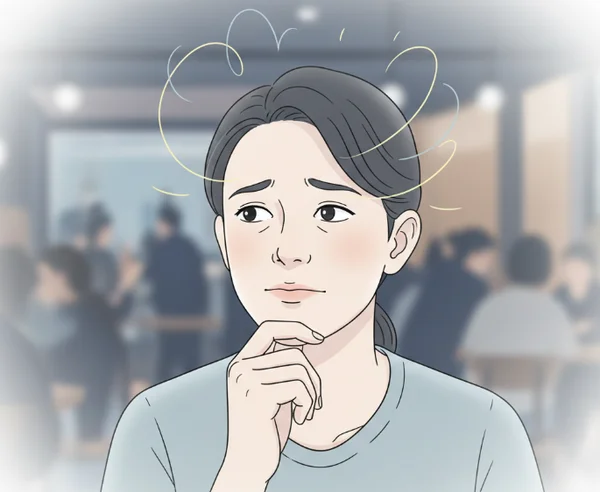
Understanding the Core Differences Between Agoraphobia and PTSD
While both conditions involve high levels of anxiety, they stem from different psychological roots. Agoraphobia vs PTSD differences usually center on why the person feels afraid and what they are trying to avoid. One is primarily about the fear of "fear itself." The other is a response to a specific past event.
Defining Agoraphobia: Beyond Simple Fear of Crowds
Agoraphobia is often misunderstood as just a "fear of open spaces." In reality, it is much more complex. It is an anxiety disorder where a person fears and avoids places that might cause them to panic. They worry about feeling trapped, helpless, or embarrassed.
Common triggers include public transport, open spaces like parking lots, or standing in long lines. The core of agoraphobia is the fear that escape will be difficult if a panic attack happens. You can start your test to see if these specific patterns match your current feelings.
PTSD: When Trauma Creates Persistent Anxiety Patterns
Post-Traumatic Stress Disorder (PTSD) is a mental health condition triggered by witnessing or experiencing a terrifying event. Unlike agoraphobia, which is situational, PTSD is rooted in a memory. People with PTSD often experience "flashbacks." These moments make them feel as though the trauma is happening all over again in the present.
PTSD symptoms fall into four categories: intrusive memories, avoidance, negative thought patterns, and heightened reactions. These may include feeling jumpy or emotionally numb. While a person with PTSD might avoid public places, they usually do so because those places remind them of the trauma. They are not necessarily fearing a panic attack itself.
Trigger Differences: Situational vs Trauma-Related Cues
The easiest way to tell the two apart is to look at the triggers. In agoraphobia, the trigger is usually a physical environment. Someone with agoraphobia might fear a shopping mall for its size and crowds. They often worry about heart palpitations or getting trapped without an exit.
In PTSD, triggers are often "cues" that link back to the traumatic event. This could be a specific smell, a loud noise, or a certain date. If a person was involved in a car accident, they might avoid driving. This looks like agoraphobia, but the root is the specific memory of the crash. This is what we call trauma induced anxiety.
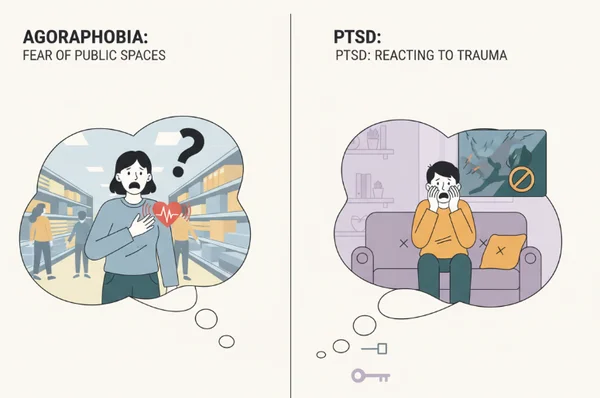
Identifying Overlapping Symptoms and Common Misdiagnoses
It is very common for people to confuse these two conditions. The human body has a limited number of ways to express "danger." Because of this, the physical symptoms can look nearly identical to an observer. This often leads to a panic disorder misdiagnosis or general confusion.
Shared Symptoms: Panic Attacks and Avoidance Behaviors
Both agoraphobia and PTSD feature two major symptoms: panic attacks and avoidance. During a panic attack, you might experience a pounding heart and sweating. You may also feel trembling and a sense of impending doom. Both conditions also drive people to shrink their "world."
Avoidance is the most visible behavior. A person might stop going to work or stop seeing friends. Some may refuse to leave their house entirely. Because both conditions result in staying home, family members may struggle to know the primary cause. Using a self-screening tool or seeking professional help can provide clarity.
The Challenge of Differential Diagnosis in Clinical Practice
In psychology, "differential diagnosis" is the process of distinguishing one disorder from another. This is challenging because a person can have symptoms of both. Doctors look at the timeline of the symptoms. Did the fear start after a specific accident (PTSD)? Or did it start with a random panic attack in a grocery store (Agoraphobia)?
Clinical professionals also look at the content of thoughts. If the thought is "I’m going to die of a heart attack in this crowd," it leans toward agoraphobia. If the thought is "Someone here is going to hurt me like before," it leans toward PTSD.
Why Agoraphobia is Often Mistaken for Anxiety Disorders
Agoraphobia is frequently grouped with Social Anxiety Disorder or General Anxiety Disorder. However, the motivation is different. A person with social anxiety fears being judged by others. A person with agoraphobia fears the physical symptoms of panic.
Agoraphobia often develops as a complication of Panic Disorder. Because of this, it is sometimes mislabeled as "just a bad case of nerves." Using a dedicated agoraphobia test can help clarify your symptoms. It determines if your avoidance is specifically tied to the fear of being trapped.
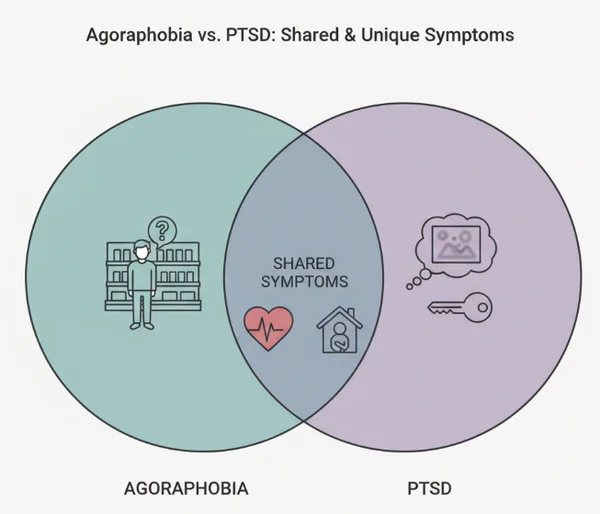
When Both Conditions Co-occur: Understanding Complex Cases
It is possible to have both agoraphobia and PTSD at the same time. This is known as "comorbidity." When this happens, the symptoms can feel twice as heavy. The person must deal with both traumatic memories and a fear of the environment.
Recognizing Comorbidity: When Agoraphobia Develops After Traumatic Events
Sometimes, a traumatic event happens in a public place. For example, if someone is robbed in a park, they may develop PTSD from the assault. However, they may also develop agoraphobia. They now associate all parks and open spaces with a lack of safety.
In these cases, the agoraphobia is a secondary defense mechanism. The brain decides that staying home is the only way to remain safe. This creates a complex cycle. The trauma fuels the agoraphobia, and the agoraphobia prevents the person from moving past the trauma.
How Trauma Can Aggravate Existing Agoraphobic Symptoms
If a person already has mild agoraphobia, a traumatic event can act like "gasoline on a fire." A minor fear of crowds can turn into a complete inability to leave the bedroom. The trauma reinforces the belief that the world is inherently dangerous.
Understanding this link is vital for recovery. You cannot simply "face your fears" of the mall if you have unprocessed trauma. Both need to be addressed to see real progress.
Treatment Approaches for Co-occurring Agoraphobia and PTSD
Treating both conditions requires a specialized approach. Often, therapists use Cognitive Behavioral Therapy (CBT) for agoraphobia. They may use "Exposure Therapy" or EMDR (Eye Movement Desensitization and Reprocessing) for PTSD.
- CBT: This helps you change the way you think about panic symptoms. You can also find panic attack management tips to help navigate these moments.
- Exposure Therapy: This slowly helps you return to feared places in a safe, controlled way.
- EMDR: This helps the brain process traumatic memories so they no longer feel "active" or threatening.
By addressing both issues, you can manage trauma-induced anxiety and situational fear at the same time.
Practical Self-Assessment Tools and Next Steps
Many people find that naming their experience makes the path to recovery clearer. The next step is anxiety differential diagnosis. This involves figuring out which symptoms are most dominant in your life.
Questions to Help Differentiate Your Symptoms
To help distinguish between these two, try asking yourself these three questions:
- When I feel afraid in public, am I thinking about a specific past event, or am I worried about how my body feels? (Past event suggests PTSD; body sensations suggest Agoraphobia).
- Would I feel safe in this crowded place if my best friend or a doctor were standing right next to me? (If yes, it is more likely Agoraphobia).
- Do I have nightmares or "flashbacks" that feel like I am reliving a memory? (If yes, it is more likely PTSD).
When to Seek Professional Evaluation
You should seek professional help if your fear prevents you from working, going to school, or maintaining relationships. If you use alcohol or substances to cope with leaving the house, it is time to speak with a doctor. Mental health professionals can provide a formal diagnosis and create a treatment plan tailored to your needs.
How Our Agoraphobia Test Can Help Initial Assessment
Self-awareness is a powerful tool. Our online tool is designed to help you look at your symptoms objectively. It uses scientifically-informed questions to evaluate your risk level for agoraphobia.
The test is free, quick, and completely anonymous. Within two minutes, you will receive a summary report. If you want a deeper look, you can request an AI-driven personalized analysis. This document is helpful to bring to a doctor's appointment to start a productive conversation.

Your Path to Clarity Begins with Understanding
Distinguishing between agoraphobia and PTSD isn't always easy, but it is necessary for getting the right treatment. Agoraphobia focuses on the fear of being trapped during a panic attack. PTSD focuses on the long-lasting impact of a traumatic memory.
Remember, you don't have to figure this all out alone. Whether you are dealing with one condition or a mix of both, there are proven ways to manage your symptoms. You can reclaim your freedom.
Take the first step today by identifying your patterns. You can take the agoraphobia screening test to get your free results now and gain the insight you need to move forward. Clarity is the foundation of courage.
Frequently Asked Questions
What are the key differences between agoraphobia and PTSD?
The primary difference lies in the source of the fear. Agoraphobia is the fear of having a panic attack in a place where escape is difficult. PTSD is a reaction to a specific traumatic event from the past. While both lead to avoidance, agoraphobia centers on the physical sensation of panic, whereas PTSD centers on the memory of the trauma.
Can you have both agoraphobia and PTSD simultaneously?
Yes, this is called comorbidity. It often happens when a traumatic event occurs in a public place. This leads the person to fear both the memory of the event and the environment where it happened. If you suspect this is the case, you can use our tool to screen for the agoraphobic side of your symptoms.
How can I tell if my anxiety stems from trauma or agoraphobia?
Look at your triggers. If your anxiety is triggered by things that remind you of a specific incident, like a sound or smell, it may be trauma-related. If your anxiety is triggered by the environment itself because you fear getting sick or panicking, it is likely agoraphobia.
Is one condition considered more serious than the other?
Both conditions can deeply impact daily life, but healing is possible with the right support. What matters most is finding a treatment plan that addresses your unique needs. The level of impact depends on how much the symptoms interfere with your daily functioning.
What treatments are effective for agoraphobia vs. PTSD?
Both respond well to Cognitive Behavioral Therapy (CBT). However, PTSD treatment often includes specialized trauma therapies like EMDR. Agoraphobia treatment usually focuses on gradual exposure, where you slowly practice entering feared environments. You can find more information on symptoms and next steps through our online resources.