Agoraphobia Test Guide: Gradual Exposure Steps
Feeling like the world outside is too large or too dangerous is an exhausting way to live. Many people find themselves staying indoors more often, avoiding crowded places, or feeling a deep sense of panic at the thought of leaving their safe zone. If you have recently wondered about these feelings, you may have considered taking an agoraphobia test to understand what is happening.
Acknowledging your anxiety and seeking to understand it shows real courage. It's normal to feel overwhelmed when you see your results. But knowledge is the most powerful tool for recovery. How can you move from feeling trapped to feeling free? The answer often lies in a proven method called gradual exposure.
We're here to walk alongside you on this journey. We will explain how to interpret your agoraphobia test results and how to use them to build a step-by-step plan for getting your life back. You do not have to do everything at once; you just need to start.
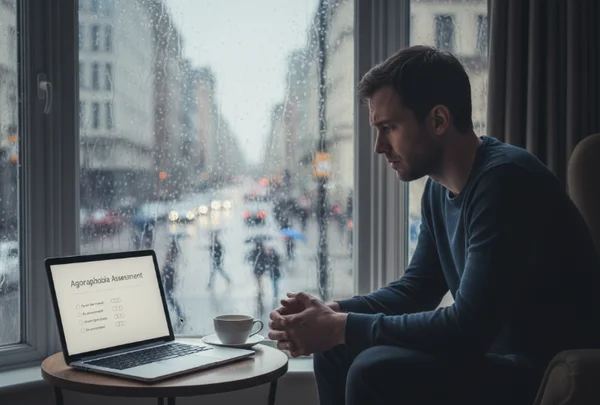
Understanding Your Agoraphobia Test Results
When you complete a screening tool, you receive a snapshot of your current mental state. This is not a permanent label. Instead, it is a map that shows where you are right now so you can decide where to go next. Understanding these results helps remove the mystery and fear surrounding your symptoms.
Decoding Your Risk Level: Low, Moderate, or High
Most screening tools categorize your symptoms into risk levels. A "Low" risk result might mean you have occasional anxiety in public but generally maintain your routine. A "Moderate" risk indicates that your world is starting to shrink, and you may be avoiding specific places like malls or public transit.
A "High" risk result suggests that agoraphobia is significantly impacting your daily life, perhaps making it difficult to leave your home at all. No matter which level you fall into, remember that these levels are fluid. By using the right strategies, you can move from a high-risk category to a lower one over time.
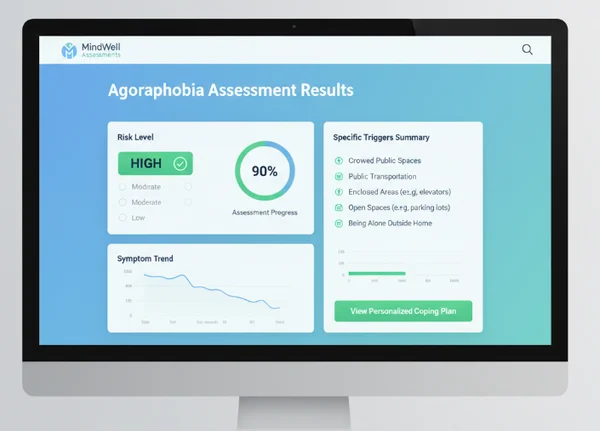
What Your Test Results Reveal About Your Specific Triggers
One of the most valuable parts of an online assessment is identifying your triggers. Agoraphobia is rarely about a "fear of open spaces" alone. For some, the trigger is being in a place where escape feels difficult, such as a cinema or a bridge. For others, it is the fear of having a panic attack in front of strangers.
When you see your results, look closely at which questions sparked the strongest emotional response. Our AI-driven reports can even help you highlight patterns you might have missed. Knowing exactly what scares you allows you to face those specific fears rather than fighting a vague sense of dread.
Normalizing Your Reaction: Why Results Don't Define Your Future
It is common to feel a sense of shame or sadness when a test confirms your struggles. However, these reactions are a normal response to a difficult condition. Your brain is trying to protect you from perceived danger; it is simply being overprotective.
A test result is a data point, not a destiny. Thousands of people have moved from being completely homebound to traveling the world. The fact that you are looking for information today proves that you are ready for change. Your future is built on the actions you take today, not the score you received on a quiz.
Building Your Agoraphobia Fear Hierarchy
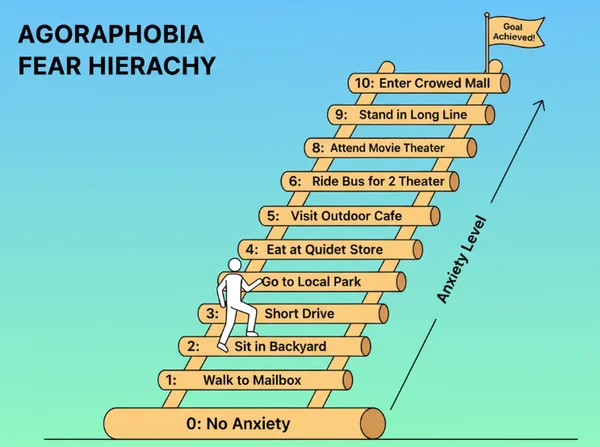
Once you understand your triggers, the next step is to organize them. You cannot overcome agoraphobia by jumping into your scariest situation immediately. That would be like trying to run a marathon without training. Instead, you need a "Fear Hierarchy," which is a ladder of challenges that get progressively harder.
Creating a Comprehensive Fear Inventory
Start by writing down every situation that causes you anxiety or makes you want to avoid it. Be specific. Instead of writing "going outside," write "walking to the end of the driveway" or "standing in line at the grocery store."
Don't worry about the order yet. Just get everything out of your head and onto paper. This list might include things like driving on the highway, sitting in a crowded cafe, or even just opening the front door. To make this list more accurate, it is often helpful to start your test again to see if any new triggers come to mind.
Organizing Fears by Anxiety Level: The 0-10 Scale
Now, look at your list and give each item a score from 0 to 10. This is often called the Subjective Units of Distress Scale (SUDS).
- 0-2: Very low anxiety. You feel a bit uneasy, but you can do it.
- 3-5: Moderate anxiety. Your heart rate might increase, and you feel a strong urge to leave.
- 6-8: High anxiety. You feel a physical sense of panic and want to avoid the situation entirely.
- 9-10: Extreme panic. This is your "worst-case scenario" situation.
Selecting Your Starting Point: Beginning with Manageable Challenges
The secret to successful gradual exposure is starting in the "Low" range (levels 2 or 3). If you start with a level 10, you will likely experience too much trauma and give up. By starting small, you prove to your nervous system that you are safe.
If walking to the mailbox is a level 3 for you, that is your starting point. You want a challenge that feels "uncomfortable but doable." Once that level 3 task no longer causes anxiety, it becomes a level 1, and you can move up to the next item on your ladder.
Implementing Your Gradual Exposure Plan
Knowing what to do is different from actually doing it. Implementation is where the real change happens. Gradual exposure works through a process called habituation. This means that if you stay in a feared situation long enough without running away, your brain eventually realizes there is no actual danger, and your anxiety naturally drops.
The 10-Minute Exposure Technique: Starting Small
When you begin an exposure task, commit to staying in the situation for at least 10 minutes. If you leave as soon as you feel anxious, you reinforce the idea that the situation is dangerous.
For example, if you're practicing standing on your front porch, stay there even if your heart starts to race. Watch the clock. Usually, after 5 or 10 minutes, the peak of anxiety will pass. This "10-minute rule" helps you ride the wave of panic until it subsides.
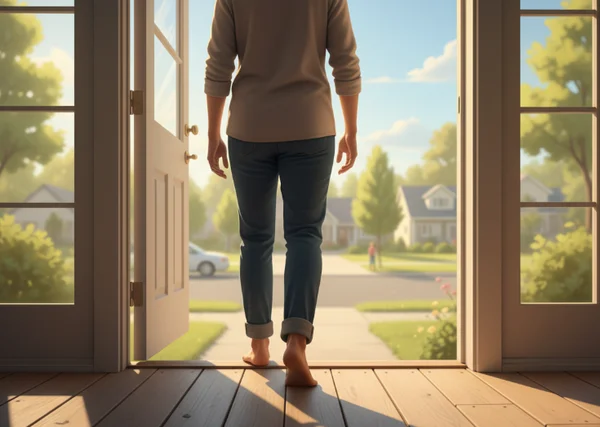
Progressive Steps: Expanding Your Comfort Zone
As you master your level 3 tasks, begin moving toward level 4 and 5. If your goal is to visit a busy supermarket, your progression might look like this:
- Drive to the supermarket parking lot and sit in the car for 10 minutes.
- Walk to the entrance of the store and back to the car.
- Walk inside the store and buy just one item at a self-checkout.
- Go during a busy time and wait in a staffed checkout line.
Each step builds the "courage muscle" you need for the next one.
Tracking Your Progress: Anxiety Logs and Success Celebrations
Keep a simple journal of your exposures. Record the date, the task, and your anxiety level before and after. You will notice that tasks that were once an "8" slowly become a "3."
It is also vital to celebrate your wins. If you completed a task that scared you, acknowledge it. This positive reinforcement helps rewire your brain to associate outside activities with success rather than just fear. Overcoming agoraphobia is hard work, and you deserve credit for every step forward.
Adjusting Your Approach as You Advance
Recovery is rarely a straight line. Some days you will feel like a superhero, and other days you might feel like you’ve gone backward. The key is to be flexible and stay committed to the process.
When to Intensify Your Exposure Challenges
How do you know when it’s time to move up the ladder? A good rule of thumb is to move to the next challenge once your current task consistently produces an anxiety score of 2 or lower.
If you can walk to the park and feel bored instead of scared, you are ready for something harder. Don't rush, but don't stay in your "new" comfort zone for too long. Growth happens at the edge of discomfort. To see how much your overall risk has changed, you can get your report periodically to track your long-term improvement.
Managing Setbacks: The Art of Self-Compassion
You might have a day where a simple task suddenly feels impossible. This is not a failure; it is a setback. Setbacks can be caused by stress, lack of sleep, or even physical illness.
When this happens, practice self-compassion. Don't beat yourself up. Instead, temporarily move one step back down your ladder. If you couldn't handle the mall today, go back to the parking lot. Keeping the momentum is more important than the speed of your progress.
Integrating Mindfulness Techniques with Exposure Therapy
Mindfulness can be a powerful partner to exposure. While you are in a feared situation, try "grounding" yourself. Use the 5-4-3-2-1 technique:
- Identify 5 things you can see.
- 4 things you can touch.
- 3 things you can hear.
- 2 things you can smell.
- 1 thing you can taste.
This keeps you in the present moment rather than letting your mind spiral into "what-if" scenarios.
Knowing When to Seek Professional Support
While self-help and gradual exposure are highly effective, they are not always enough to go it alone. Recognizing when you need a partner in your recovery is a sign of wisdom, not weakness.
Signs That Your Recovery Needs Professional Guidance
You should consider reaching out to a therapist if:
- Your anxiety leads to severe physical symptoms that worry you.
- You find yourself unable to start even the smallest exposure task.
- You are struggling with depression or thoughts of hopelessness.
- You have a history of trauma that feels connected to your agoraphobia.
A professional can provide a safe environment to explore these deeper issues while guiding your exposure plan.
Finding the Right Therapist: Specialized Exposure Therapy
Not all therapy is the same. For agoraphobia, look for a therapist who specializes in Cognitive Behavioral Therapy (CBT) and Exposure and Response Prevention (ERP).
These therapists understand the mechanics of anxiety and won't just ask you how you feel; they will give you practical homework. Many therapists now offer "telehealth" or online sessions, which is perfect for those who are still finding it difficult to leave the house.
Combining Self-Directed Efforts with Professional Support
You don't have to choose between doing it yourself and seeing a doctor. Many people find the most success by using online tools and self-directed exposure in between therapy sessions.
Your therapist can help you refine your fear hierarchy, and you can use an online agoraphobia test to provide your therapist with data about your progress. This collaborative approach ensures you have both the expert guidance and the personal agency needed for a full recovery.
Taking the Next Step
Agoraphobia can make your world feel very small, but that world is waiting to expand again. By taking an assessment, building a fear hierarchy, and practicing gradual exposure, you are taking control of your life.
Remember, you don't need to be fearless to take action—just willing to try. You only need to be brave enough to take the next small step. Whether that step is walking to your front gate or simply learning more about your condition, it counts.
Are you ready to see where you stand? The best way to begin your personalized exposure plan is to understand your unique triggers. Take our free online test today and receive the insights you need to start your journey back to the world.
The Takeaway
How long does gradual exposure therapy typically take to show results?
Most people begin to see a noticeable reduction in their anxiety within 8 to 12 weeks of consistent practice. However, small wins—like feeling calmer during a short walk—can happen much sooner. Consistency is more important than speed.
Can I implement exposure techniques without professional guidance?
Yes, many people use self-directed exposure for mild to moderate agoraphobia. However, it is essential to stay informed and move at a pace that is challenging but not traumatizing. If you feel stuck, it is always a good idea to try the test and consult a professional.
What should I do if my anxiety increases during exposure exercises?
It is normal for anxiety to increase during the first few minutes of an exercise. The goal is to stay in the situation until the anxiety begins to drop. If you feel a full panic attack coming on, try to stay put and use slow, deep breathing until the peak passes.
How do I know when I'm ready to move to more challenging situations?
You are ready when your current task feels routine or only causes a "2" or "3" on your anxiety scale. If you can perform the task three times in a row without significant distress, it is time to climb to the next step of your ladder.
Are there any situations where self-directed exposure might not be appropriate?
If you have underlying heart conditions, severe respiratory issues, or are experiencing a mental health crisis, you should consult a doctor before starting a physical exposure program. Safety and health always come first.