Agoraphobia Test & Graded Exposure: Your Ultimate Self-Help Guide
Feeling trapped by the invisible walls of agoraphobia can be isolating and overwhelming. The fear of certain places and situations may shrink your world, making everyday tasks feel like impossible challenges. But what if there was a structured, gentle way to push back against those walls and reclaim your freedom, one step at a time? This guide is here to introduce you to graded exposure, a powerful self-help technique to manage your fears. Understanding your starting point is crucial, which is why a confidential agoraphobia test can be an invaluable first step. How do I tell if I'm developing agoraphobia? This journey begins with self-awareness and a single, brave decision to move forward.
This guide provides a beginner-friendly approach to building your own "fear ladder." We will explore how to take those first steps toward recovery at your own pace. The path to managing agoraphobia is not about giant leaps but about a series of small, consistent, and courageous movements. Before you begin, you can understand your symptoms with a quick assessment.
Understanding Graded Exposure: How to Beat Agoraphobia
Graded exposure is a cornerstone of Cognitive Behavioral Therapy (CBT), one of the most effective treatments for anxiety disorders. Instead of avoiding the things that scare you—a behavior that only strengthens fear over time—you gradually and repeatedly expose yourself to them. This process helps your brain learn that these situations are not as dangerous as they feel, reducing your anxiety response. It’s about facing your fears, but on your own terms and in a way that feels manageable.
This method isn’t about throwing yourself into the deep end. The key is "graded," meaning you start with something that causes only mild anxiety and slowly work your way up to more challenging situations. Each successful step builds confidence and weakens the connection between a specific trigger and your fear response.

What is Graded Exposure Therapy, Really?
Think of exposure therapy as a form of behavioral conditioning for your brain. Right now, your brain might associate going to a supermarket with overwhelming panic. Graded exposure works to create a new association: going to the supermarket with a feeling of accomplishment and safety. It’s a systematic process of confronting feared situations, thoughts, and feelings until they no longer trigger the same level of distress.
You control the pace entirely. You decide what the steps are and when you are ready to move to the next one. This sense of control is empowering and is a critical part of what makes the therapy so effective for many people. It transforms you from a passive victim of anxiety into an active participant in your recovery.
The Psychology Behind Facing Your Fears Gradually
The science behind graded exposure is based on a principle called habituation. When you stay in a feared situation long enough, your anxiety will naturally decrease. The initial spike of panic is your body's "fight or flight" system kicking in, but this system cannot stay activated forever. By remaining in the situation, you give your nervous system a chance to calm down, teaching it that the feared outcome isn't happening.
With each exposure, the initial anxiety spike gets lower, and it subsides more quickly. This process helps in anxiety management by fundamentally rewiring your brain's fear circuits. You learn through direct experience that you can handle the discomfort and that the anxiety will pass without you needing to escape.
Building Your Agoraphobia Fear Ladder: Step-by-Step
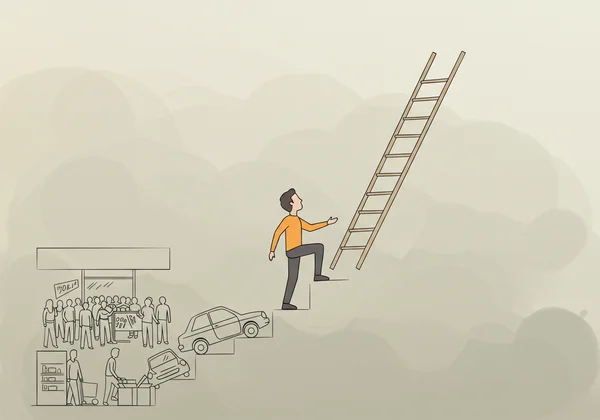
The "fear ladder" is the central tool of graded exposure. It is a personalized hierarchy of your fears, ranked from the least scary to the most terrifying. Creating this ladder is a critical act of self-exploration and planning that sets the stage for your success. It breaks down an overwhelming goal, like "overcome agoraphobia," into a series of achievable mini-goals.
The first step is always understanding what you’re up against. What specific situations do you avoid? What are your unique triggers? A clear picture of your fears is essential before you can start building your ladder. For a comprehensive starting point, consider using an agoraphobia self-assessment to identify key areas of concern.
Identifying Your Avoidance Triggers and Fear Hierarchy
Before you can climb the ladder, you need to build it. Start by brainstorming all the situations and places you avoid due to fear. Be as specific as possible. Instead of "going out," write down "walking to the mailbox," "driving to the next town," or "standing in a checkout line." These avoidance behaviors are the rungs of your ladder.
Once you have a list, rate each situation on a scale of 0 to 100, where 0 is no anxiety and 100 is extreme panic. This rating system helps you create your fear hierarchy. Your first step on the ladder should be a situation you rated around 20-30, something that is challenging but absolutely doable. Your final goal might be an 80-90, with several steps in between.
Crafting Your Personalized Exposure Steps
Now, arrange your list in ascending order of fear, from the lowest score to the highest. This is your fear ladder. An example for someone whose goal is to go grocery shopping might look like this:
- Step 1 (20/100): Sit in the car in the driveway for 5 minutes.
- Step 2 (30/100): Drive around the block.
- Step 3 (40/100): Drive to the grocery store parking lot and sit in the car for 5 minutes.
- Step 4 (50/100): Walk to the entrance of the store, then return to the car.
- Step 5 (60/100): Walk into the store for 2 minutes and then leave.
- Step 6 (70/100): Walk into the store, pick up one item, and go through self-checkout.
These baby steps make the final goal feel much less daunting. Your ladder should be tailored specifically to you and your fears.
How to Safely Progress Up Your Fear Ladder
The rule of thumb for this gradual process is to stay on one step until your anxiety level decreases significantly (by about 50%) while you are doing it. This might take one attempt or it might take ten. Be patient with yourself. The goal is not to be fearless but to learn that you can tolerate the fear until it subsides.
Repeat each step regularly, perhaps a few times a week. Once a step feels significantly less scary, you are ready to move to the next one. If a step feels too big, it’s perfectly okay to break it down into even smaller micro-steps. This journey is a marathon, not a sprint.
Practical Tips for Agoraphobia Self-Help & Success
Embarking on a graded exposure plan is a brave act of self-care. To support your efforts, integrating other self-help strategies can make the process smoother and more effective. These tools can help you manage the anxiety that arises during exposure tasks and build overall resilience.
Think of these tips as your support kit. They are techniques you can rely on when the climb feels tough, ensuring you have the resources to keep moving forward. Acknowledging your starting point is part of this preparation; a free agoraphobia test can provide that initial clarity.
Incorporating Mindfulness and Breathing Techniques
When anxiety spikes, your breathing often becomes shallow and rapid, which can intensify feelings of panic. Practicing deep, diaphragmatic breathing can activate your body's relaxation response. Before and during an exposure task, take slow, deep breaths: inhale through your nose for four counts, hold for four, and exhale through your mouth for six.
Mindfulness involves observing your anxious thoughts and feelings without judgment. Instead of fighting them, simply acknowledge them: "There is the feeling of fear. I notice my heart is beating fast." This creates distance and helps you realize that you are not your anxiety. These coping strategies are invaluable allies.

The Role of a Support System (and When to Seek Professional Help)
You do not have to do this alone. Share your plan with a trusted friend or family member. They can offer encouragement, celebrate your wins, or even accompany you on some of the early exposure tasks. Having someone who understands can make a world of difference.
However, it is crucial to recognize the limits of self-help. Graded exposure is a powerful tool, but if your symptoms are severe, or if you feel stuck, seeking professional guidance from a therapist is a sign of strength. A professional can provide a formal diagnosis and create a comprehensive treatment plan with you. This guide is for informational purposes and is not a substitute for professional medical advice.
Tracking Your Progress and Celebrating Small Wins
Keep a journal to track your exposure practice. Before each task, rate your expected anxiety. Afterward, rate your actual peak anxiety. You will likely notice that your actual anxiety is often lower than what you anticipated, which is a powerful realization. This log provides concrete evidence of your self-paced recovery.
Acknowledge every single success, no matter how small it seems. Completing a step that once felt impossible is a massive achievement. Celebrate these victories to reinforce your progress and keep your motivation high. Each celebrated win builds momentum for the next step on your ladder.
Taking the First Step: Your Journey to Overcome Agoraphobia
Graded exposure offers a hopeful and empowering path toward managing agoraphobia. It is a journey of reclaiming your life not through one giant leap, but through a series of small, intentional, and courageous steps. By building your fear ladder and patiently climbing it, you teach your brain that you are capable and that the world is safer than your anxiety suggests.
Remember, the first step is always understanding. Knowing where you stand is the foundation for building your ladder. Your journey to freedom starts with a single decision to move forward. Take that first step today by clarifying your symptoms with our confidential and free online agoraphobia test. You have the strength to begin this journey.

Frequently Asked Questions About Agoraphobia Self-Help
Can you be agoraphobic and still leave the house?
Yes, absolutely. Agoraphobia exists on a spectrum. Some people may be completely housebound, while others can leave the house but feel intense anxiety in specific situations like using public transportation, being in crowded places, or waiting in lines. Their "safe zones" might be limited to a few familiar routes or locations.
What not to do when experiencing agoraphobia?
The most important thing to avoid is complete avoidance. While escaping a feared situation provides temporary relief, it strengthens the fear in the long run. Also, avoid self-criticism. Berating yourself for feeling anxious is counterproductive. Practice self-compassion and acknowledge the courage it takes to face these challenges.
How do I know if I'm developing agoraphobia?
Signs of developing agoraphobia include a growing fear of situations where escape might be difficult, a reliance on a "safe person" to accompany you, and an increasing pattern of avoiding places you used to go. If you find your world shrinking due to these fears, it may be a sign. An online screening test can offer preliminary insights into your symptoms.
What are the levels of agoraphobia, and where do I start my ladder?
While there are no official "levels," clinicians often describe agoraphobia in terms of severity: mild, moderate, or severe, based on how much it impacts daily functioning. To know where to start your ladder, you must first identify your personal fear hierarchy. A tool like the Agoraphobia Test can help you pinpoint which situations trigger you most, giving you a clear idea of what your lowest (easiest) and highest (hardest) rungs should be.