Agoraphobia Recovery Roadmap: Workbook Templates
Taking the first step to understand your feelings is a huge achievement. Many people who complete an online agoraphobia test feel a sense of clarity, but also wonder, "What should I do next?" If you've just gained insights from a self-assessment, this is the perfect place to be. This guide provides a clear agoraphobia recovery roadmap, complete with practical workbook templates.

This journey of recovery begins with a structured plan. The insights you gain from a self-assessment are the foundation, and these tools are the framework to build upon. We've designed these science-informed templates to help you turn your understanding into action. Whether you're just starting to notice symptoms or managing more significant challenges, this roadmap will empower you to move forward at your own pace. For a clear starting point, you can always take our free test to get personalized insights.
Self-Paced Exposure Therapy Planning
Exposure therapy is a well-established and effective technique for managing agoraphobia. It involves gradually and safely facing the situations you fear until the anxiety subsides. This process, known as habituation, retrains your brain to understand that these situations are not dangerous.
A self-paced plan allows you to control the process entirely. You decide what to face and when, ensuring you never feel overwhelmed. This sense of control is crucial for building confidence and making steady, long-term progress. The goal is not to eliminate fear overnight but to learn that you can manage it.
Creating Your Personalized Exposure Hierarchy
An exposure hierarchy is a list of feared situations, ranked from least to most anxiety-inducing. It’s your personal ladder for recovery. Creating one helps you break down what feels like an impossible challenge into small, manageable steps.
Start by brainstorming all the situations, places, or activities you avoid due to anxiety. Don't filter yourself; write down everything that comes to mind. Then, rate each item on a scale of 0 to 100, where 0 is no anxiety and 100 is extreme panic.
Here is a simple template to get you started:
- Step 1: Brainstorm Fears: (e.g., walking to the mailbox, driving around the block, going to a quiet local store, using a bus, visiting a busy mall).
- Step 2: Rate Each Fear (0-100):
- Walk to the end of the driveway (Anxiety Score: 15)
- Stand in a short line at a small shop (Anxiety Score: 30)
- Drive on a quiet street for 5 minutes (Anxiety Score: 45)
- Go to the supermarket during off-peak hours (Anxiety Score: 60)
- Step 3: Build Your Ladder: Arrange these items from the lowest score to the highest. This is your personalized exposure hierarchy.
Gradual Exposure Implementation Strategies
Once your hierarchy is ready, you can begin practicing. The key is to start with the easiest task—one that causes mild but manageable anxiety. Stay in the situation long enough for your anxiety to decrease noticeably, which usually takes anywhere from a few minutes to an hour.
Here are some strategies for successful implementation:
- Start Low and Go Slow: Begin with an activity you rated low on your hierarchy (e.g., 20-30 out of 100). Don't rush to the top of the ladder.
- Be Consistent: Try to practice an exposure exercise several times a week. Consistency is more important than intensity.
- Don't Use Safety Behaviors: Avoid things like constantly checking your phone, listening to music to distract yourself, or only going with a "safe" person unless it's part of your plan. The goal is to learn you can handle the situation on your own.
- Stay Until Anxiety Drops: Remain in the feared situation until your anxiety level reduces by about half. This teaches your brain that the fear will pass.
- Reward Yourself: Acknowledge your courage after each practice. Celebrating small wins builds momentum and motivation for the next step.
Symptom Progress Tracking Templates
How do you know if you're making progress? Tracking your symptoms provides clear, objective feedback on your recovery journey. It helps you see improvements that you might otherwise overlook on a difficult day and identifies patterns in your anxiety.
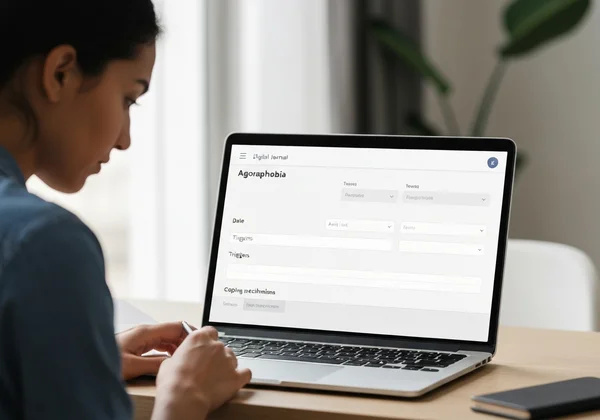
Monitoring your symptoms transforms abstract feelings into concrete data. This information is incredibly valuable for both your personal self-management and for sharing with a mental health professional. It helps you celebrate your successes and understand your triggers more deeply. To get a baseline of your symptoms, a confidential agoraphobia quiz can be a very helpful first step.
Daily Symptom Monitoring System
A daily log helps you capture your experiences in the moment. It can be a simple journal or a structured worksheet. Tracking daily allows you to see connections between your activities, thoughts, and anxiety levels.
Here’s a template for a daily symptom monitoring log:
- Date:
- Overall Anxiety Level (1-10):
- Situation/Trigger: (What were you doing or thinking about?)
- Physical Symptoms: (e.g., racing heart, sweating, dizziness)
- Anxious Thoughts: ("I'm going to have a panic attack," "I can't escape.")
- Action Taken: (Did you leave? Did you use a coping skill? Did you stay?)
- Outcome: (How did your anxiety change after your action?)
Filling this out takes just a few minutes a day but provides powerful insights over time. It helps you recognize that bad days are just that—days—and not a permanent setback.
Monthly Progress Assessment Tools
While daily tracking is great for details, a monthly review helps you see the bigger picture. A monthly assessment allows you to step back and evaluate your overall progress, celebrate major milestones, and adjust your goals for the upcoming month.
Use this simple monthly assessment worksheet to reflect on your journey:
- Month/Year:
- Biggest Accomplishment This Month: (e.g., "I went to the grocery store alone.")
- Challenges Faced: (e.g., "I avoided a social invitation due to anxiety.")
- Average Weekly Anxiety (1-10): (Review your daily logs to find an average.)
- Goals for Next Month: (e.g., "Practice the next step on my exposure hierarchy," "Try a new breathing exercise.")
- What I've Learned About Myself: (Reflect on your triggers, strengths, and coping skills.)
This review helps you stay focused and motivated. It provides tangible evidence that your hard work is paying off, even when progress feels slow.
Relapse Prevention Worksheets
Recovery from agoraphobia rarely follows a straight path. Some days, your symptoms might feel stronger than others. This is completely normal and doesn't mean you've failed. A relapse prevention plan is a proactive strategy to help you manage these moments and get back on track quickly.
Having a plan in place gives you a sense of security. It means you are prepared. Instead of being caught off guard by a difficult day, you'll have tools and strategies ready to use. This empowers you to handle setbacks with confidence.
Identifying Early Warning Signs
Setbacks often don't appear out of nowhere. There are usually subtle early warning signs that indicate your stress or anxiety levels are rising. Learning to recognize these signs allows you to intervene early before they escalate.
Use this worksheet to identify your personal warning signs:
- Subtle Behavioral Changes:
- Are you starting to make excuses to avoid certain places again?
- Are you relying more on safety behaviors (like needing someone with you)?
- Have you stopped doing your exposure practices?
- Shifts in Thinking:
- Are you having more "what if" thoughts?
- Are you thinking in catastrophic terms (e.g., "This is going to be a disaster")?
- Are you feeling more hopeless or pessimistic about your recovery?
- Physical or Emotional Feelings:
- Are you feeling more tired or on-edge than usual?
- Is your sleep pattern disrupted?
- Do you feel a general sense of dread or unease?
Reviewing this list regularly helps you stay in tune with yourself and take supportive action when needed.
Creating Your Personal Coping Toolkit
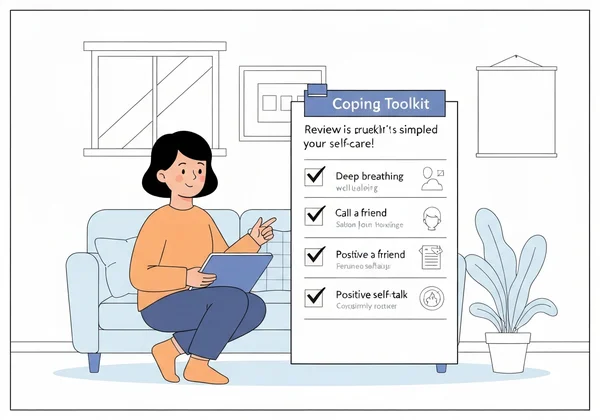
Your coping toolkit is a list of strategies that you know help you manage anxiety. When you spot an early warning sign, you can turn to this toolkit for support. The key is to create it when you are feeling calm, so it's ready when you need it most.
Here are some ideas to include in your personal coping toolkit worksheet:
- Calming Techniques:
- Deep breathing exercise (e.g., box breathing: inhale for 4, hold for 4, exhale for 4, hold for 4).
- Grounding technique (e.g., the 5-4-3-2-1 method: name 5 things you see, 4 you can touch, 3 you can hear, 2 you can smell, and 1 you can taste).
- Mindful meditation app or recording.
- Helpful Distractions:
- Call or text a supportive friend or family member.
- Listen to an engaging podcast or upbeat music playlist.
- Do a simple puzzle or play a game on your phone.
- Encouraging Self-Talk:
- Write down a list of rational statements to counter anxious thoughts (e.g., "This feeling is uncomfortable, but it is not dangerous," "I have handled this before, and I can handle it now").
- Review your progress logs to remind yourself how far you have come.
- People to Contact:
- List the names and numbers of your support system (therapist, trusted friend, family member).
Taking the Next Step in Your Journey
Managing agoraphobia is your personal journey of building skills, confidence, and self-understanding. It's not about becoming fearless—it's about discovering your own strength to face your challenges. Using tools like an exposure hierarchy, symptom trackers, and a relapse prevention plan transforms recovery from a vague hope into an actionable, structured path.
Remember, every step you take—no matter how small—is a victory. These worksheets and templates are designed to support you, but the most important tool you have is your own courage and commitment. By breaking down the process into manageable steps, you can create lasting change and reclaim your freedom.
If you are just beginning to explore these feelings, a great first step is understanding your personal symptom level. This knowledge is the foundation for your entire recovery roadmap. You can get a clear, confidential, and instant starting point when you start your self-assessment on our platform.
Frequently Asked Questions About Agoraphobia Recovery Planning
How long does it typically take to see progress with agoraphobia recovery?
Progress is highly individual and depends on factors like the severity of symptoms and the consistency of practice. Some people notice small improvements within a few weeks of starting exposure therapy. The key is to focus on steady, gradual change rather than a specific timeline.
Can these worksheets replace professional therapy for agoraphobia?
No. These worksheets are powerful self-help tools designed to support your journey, but they are not a substitute for professional medical advice or therapy. A qualified therapist can provide a formal diagnosis, personalized guidance, and support, especially for complex or severe symptoms. These tools are most effective when used alongside professional care.
What should I do if I experience a setback while following my recovery roadmap?
Setbacks are a normal part of recovery. First, be kind to yourself and avoid self-criticism. Review your relapse prevention plan and use a coping skill from your toolkit. Re-evaluate your exposure hierarchy—you may need to go back to an easier step for a short time to rebuild confidence. A setback is a learning opportunity, not a failure.
How do I know when to adjust my exposure hierarchy?
You should adjust your hierarchy when an activity no longer causes much anxiety. Once you can complete a step with a low anxiety rating (e.g., below 20-30 on a 100-point scale) consistently, it's time to move to the next item on your list. Similarly, if a step feels overwhelmingly difficult, you can break it down into even smaller, more manageable parts. Your recovery plan should be a living document that evolves with your progress. Knowing your starting point is key, which is why a free agoraphobia test can provide valuable initial direction.